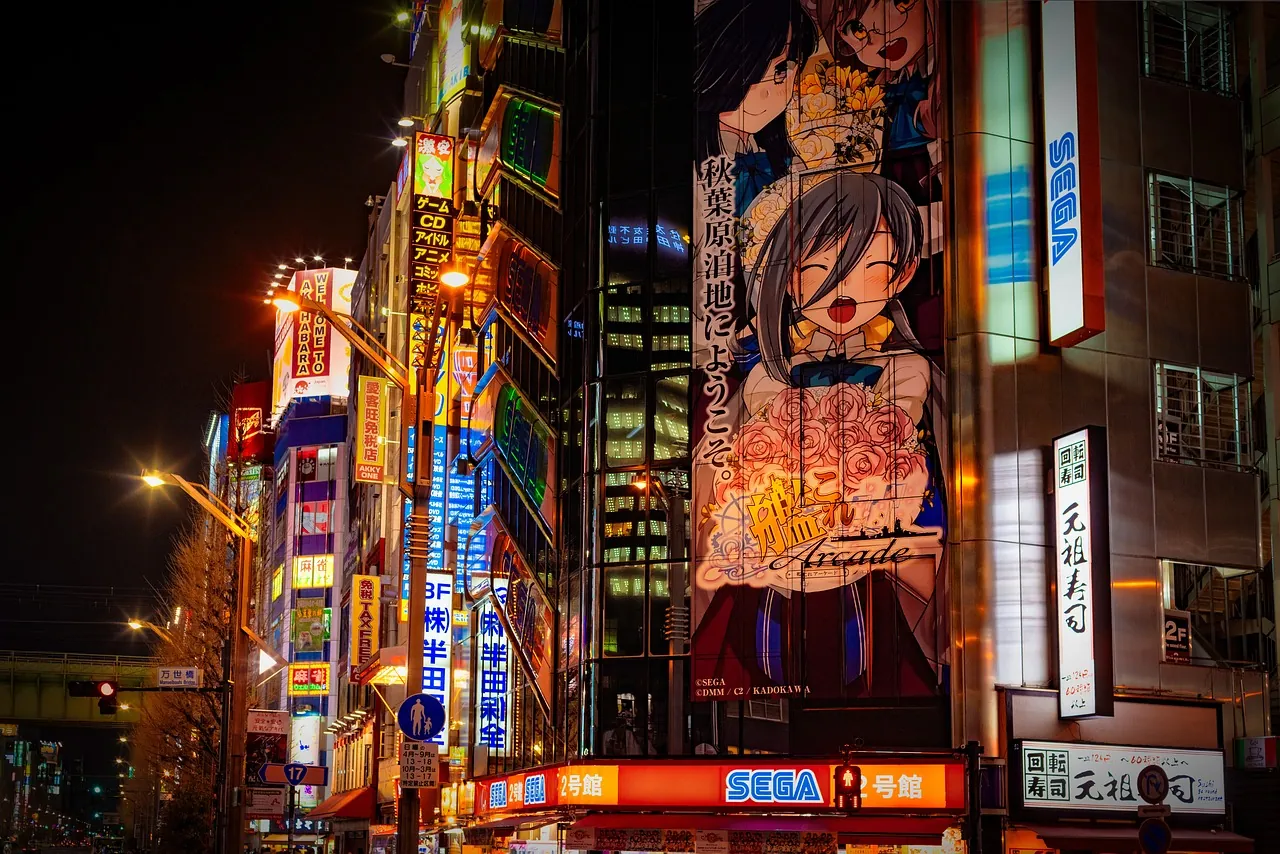
There is a moment in Akihabara that happens to almost everyone on their first visit: you step out of the station, see the neon and the giant anime figures on the building facades and the maid cafe girls in black-and-white uniforms handing out flyers, and you think you understand what this place is.
You don’t. Not yet.
Akihabara is not a theme park built around Japanese pop culture. It is a neighborhood with a specific, unusual history—one that begins with the end of a war and the problem of rebuilding a ruined country—and that history is visible in the streets today if you know what you’re looking at.
How Electric Town Was Actually Built
In 1945, Japan was rebuilding from near-total destruction. Manufacturing was starting from almost nothing, and the government had strict controls on most goods. Among the controlled commodities: wheat, rice, beef. Not controlled: surplus military radio components and electronic parts, which were being sold in enormous quantities as the American occupation decommissioned equipment.
In the open-air markets around Akihabara Station—an area heavily bombed—electronics vendors moved in. They sold vacuum tubes, condensers, switches, and wire that an increasingly technically literate Japanese population needed both for rebuilding communications infrastructure and for the growing hobbyist market in amateur radio.
The neighborhood grew with Japan’s postwar electronics boom. By the 1970s and 1980s, Akihabara was where you went to buy televisions, refrigerators, washing machines, and—crucially—the personal computers and accessories that arrived in the 1980s. The district’s identity was technical, specialist, and intensely focused on hardware.
The shift to anime, manga, and gaming merchandise began in the 1990s and accelerated through the early 2000s, as a generation of technically literate young people—the otaku (おたく)—found that the same commercial ecology supporting electronics specialists could equally support their interests. The same small-shop culture, the same concentration of specialist knowledge, the same willingness to serve customers who knew exactly what they wanted and would walk away from anything less.
Radio Kaikan: The Living Museum of the Origin
Akihabara Radio Kaikan (秋葉原ラジオ会館) is a nine-story building that has stood in various forms since 1962. The ground floor currently houses audio equipment and figure shops. The upper floors contain what the building’s name describes: radio and electronics components, vacuum tubes, capacitor assortments, vintage switches, and the accumulated inventory of specialists who have been selling here for decades.
These upper floors are not designed for casual visitors. They serve engineers and hobbyists who need a specific connector in a size no mainstream retailer stocks. But walking through them for ten minutes—hearing the technical conversations, seeing the density of components on shelves, understanding that people make special trips here for parts unavailable elsewhere—is the most direct way to understand what Akihabara actually is beneath the anime surface.
The building was rebuilt in 2011, and the lower floors now host figure shops and anime goods alongside the legacy electronics vendors. This coexistence is not contradiction. It is continuity: the same specialist culture, different domains.
The Collector’s Logic: Mandarake vs. Animate
Akihabara’s manga and anime retail divides into two distinct experiences reflecting two different orientations toward the same culture.
Animate is mainstream and contemporary. Its Akihabara store carries current season merchandise—figures, character goods, DVDs, manga volumes—from whatever anime is airing right now. It is well-organized, well-lit, and designed for a broad audience. If you want official merchandise for the series your niece is currently watching, Animate is the correct destination.
Mandarake is the collector’s domain. Six floors of used, vintage, and rare materials: vintage manga volumes from the 1970s in protective plastic sleeves; original animation cels from productions that ended before most current fans were born; figures from limited-run 1990s releases; doujinshi (fan-published manga) in quantities representing the complete output of specific creators across decades. Mandarake is organized like a serious archive, which is what it is.
Walking through Mandarake communicates something Animate does not: that this culture has history, dense and interconnected, taken seriously as history. The 1975 manga volume in its protective sleeve is not just old merchandise. It is primary source material for a tradition now five decades deep.
Maid Cafes: Performing Service as an Extreme Art Form
The maid cafes of Akihabara—approximately 200 of them in the district at any given time—are the element of its culture most frequently misunderstood by visitors from outside Japan.
The format: customers enter a cafe, are greeted by staff in maid costumes who use an affectionate language register (“Welcome home, Master/Mistress”), and are served food and drinks while staff interact through games, performances, and conversation. At many cafes, photographs with the maids are available for an additional fee; having the maid decorate your food with a drawing and a small spoken spell is standard.
This is not a sexual service. It is a theatrical extension of Japanese omotenashi (おもてなし)—the culture of hospitality—pushed to an extreme register in which the customer is cast as the protagonist of a domestic fantasy where every need is met with maximum warmth. Applied correctly—as a highly developed performance of hospitality aesthetics, themed around the visual language of domestic service—maid cafes become coherent, and the professionalism of the staff becomes visible.
The discomfort many international visitors feel comes from applying the wrong interpretive framework. The way to calibrate it: remember that Japanese service culture in general operates at a register of attentiveness that most other service cultures do not. The maid cafe is the same instinct amplified and theatricalized.
@Home Cafe is the most visitor-accessible entry point: multiple floors, professional staff, no photography restrictions beyond the paid portrait option. Expect ¥500–¥700 per drink plus a ¥500–¥1,000 service charge per person, varying by cafe.
Super Potato and the Archaeology of Gaming
Super Potato occupies three floors off the main Chuo-dori strip. The inventory is entirely retro: Famicom cartridges, Super Nintendo games in original boxes, Sega Mega Drive hardware, PC-Engine and Neo Geo items, vintage handhelds in working condition.
This is not nostalgia retail in the way Western retro game stores operate. Super Potato is an active market with pricing that reflects genuine collector demand. First-print cartridges of significant titles sell for hundreds of dollars. The inventory is continuously updated by a consistent stream of sellers.
What Super Potato communicates—like Mandarake for manga—is the depth of the archive. Japanese gaming culture has been accumulating since the late 1970s. The neighborhood that houses it takes that accumulation seriously enough to maintain dedicated multi-floor institutions for its preservation and trade.
The top-floor arcade, where the vintage machines are operational and playable, is worth the visit whether or not you buy anything. The experience of playing a 1984 Namco cabinet in the same building where it was sold new in 1984 is specific to this place.
Underground Idols: The Part Most Visitors Miss
Small performance venues are distributed throughout Akihabara—some above shops, some in basements—where independent idol groups perform ticketed shows for dedicated fan communities several times a week. These are not the polished production acts of major entertainment companies. They are small groups of young performers building careers through direct relationships with fans who buy merchandise, attend multiple shows per week, and function as organized communities around the group’s success.
The economics and social structure of underground idol fandom are an extension of the same kodawari (obsessive dedication) culture that supports Mandarake’s collectors and Super Potato’s regulars. The domain is performance rather than objects, but the intensity of engagement is identical.
When to Visit
Akihabara’s main strip—Chuo-dori (中央通り)—closes to vehicle traffic on Sundays and national holidays between roughly noon and 6 PM, becoming a pedestrian promenade. Standing in the middle of the road and looking north or south gives a visual context for the district’s scale that the crowded sidewalk cannot.
Weekday evenings have a different character: populated largely by regular customers rather than tourists, the specialist shops fully operational, the street-level competition for attention slightly reduced.
The most photogenic conditions are at dusk on any day: the neon activates while there is still color in the sky, and the visual density of signage, figures in windows, and human movement achieves its maximum intensity.
Practical Information
- Access: JR Akihabara Station (Yamanote, Sobu, Keihin-Tohoku Lines); Tokyo Metro Hibiya Line
- Main strip: Chuo-dori, running north–south from the station; most major shops within 10-minute walk
- Radio Kaikan: 1-15-16 Sotokanda, Chiyoda-ku; open 11:00 AM–8:00 PM daily
- Super Potato: 1-11-2 Sotokanda; open 11:00 AM–8:00 PM (Saturdays and Sundays from 10:00 AM)
- Mandarake: Multiple buildings; main complex 3-11-12 Sotokanda; open 12:00 PM–8:00 PM daily
- Sunday pedestrian zone: Chuo-dori closed to traffic noon–6:00 PM on Sundays and national holidays
Akihabara is where Japan’s tolerance for obsession made itself visible in commercial form. The electronics specialist who spent forty years sourcing vacuum tubes and the twenty-year-old who has memorized the production history of a specific animation studio are operating in the same tradition: taking something seriously enough to become expert, and finding a neighborhood that takes that expertise seriously in return.